


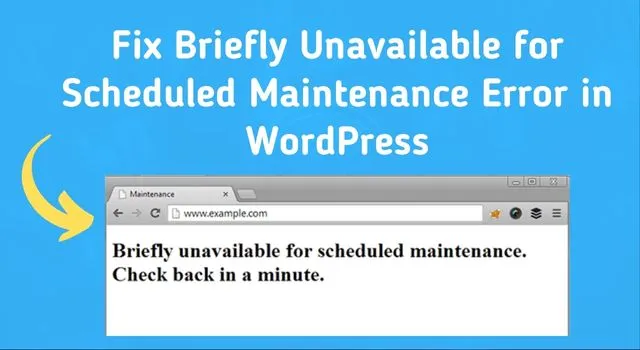
If you’ve ever tried to visit your WordPress site and seen the message “Briefly unavailable for scheduled maintenance. Check back in a minute”, you’re not alone. This is one of the most common WordPress errors — similar to the 502 Bad Gateway Error — and the good news is it’s also one of the easiest to fix.
In this guide, you’ll learn exactly what causes this error, how to fix it using multiple methods, and how to prevent it from happening again.
What Is the "Briefly Unavailable for Scheduled Maintenance" Error?
When WordPress runs an update — whether for core, themes, or plugins — it automatically creates a file called .maintenance in your root directory and puts your site into maintenance mode. During this time, all visitors see a message like:
“Briefly unavailable for scheduled maintenance. Check back in a minute.”
Under normal circumstances, this lasts only a few seconds. WordPress completes the update, deletes the .maintenance file, and your site comes back online automatically.
The problem occurs when the update process is interrupted or fails — leaving that .maintenance file behind and your site permanently stuck in maintenance mode.
What Causes This Error?
Several things can interrupt the WordPress update process and trigger this error:
- Closing the browser tab mid-update
- Server timeout due to shared hosting limitations
- PHP memory limit being exceeded during the update
- Plugin or theme conflict that crashes the update process
- Unstable internet connection dropping during the update
- Multiple simultaneous updates being run at the same time
The root cause in all cases is the same: the .maintenance file was created but never deleted.
Method 1: Delete the .maintenance File via FTP
This is the most reliable and widely recommended fix.
Step 1: Connect to Your Site via FTP
Open your FTP client (FileZilla is a popular free option). Enter your FTP credentials — hostname, username, password, and port — and connect to your server.
Tip: Your FTP credentials are usually found in your web hosting control panel under “FTP Accounts.”
Step 2: Navigate to Your Root Directory
Once connected, navigate to your website’s root directory. This is typically named public_html or www. This is the same folder that contains your wp-admin, wp-content, and wp-includes folders.
Step 3: Show Hidden Files
The .maintenance file is a hidden file (it starts with a dot). In FileZilla, go to Server → Force Showing Hidden Files to make it visible.
Step 4: Locate and Delete the .maintenance File
Look for a file named exactly .maintenance in the root directory. Right-click on it and select Delete. That’s it — the file will be removed.
Step 5: Refresh Your Website
Go back to your browser and refresh your website. The maintenance mode message should be gone and your site should be back to normal.
Method 2: Delete the File via cPanel File Manager
If you don’t have FTP access or prefer not to use an FTP client, you can do this directly from your hosting control panel.
Step 1: Log Into cPanel
Log in to your hosting account and open cPanel. Look for the File Manager icon and click it.
Step 2: Navigate to public_html
In the File Manager, navigate to your public_html folder (or your site’s root directory).
Step 3: Enable Hidden Files
Click Settings (top right of File Manager) and check the box that says “Show Hidden Files (dotfiles)”. Click Save.
Step 4: Find and Delete .maintenance
You should now see the .maintenance file listed in the root directory. Click on it to select it, then click Delete in the toolbar. Confirm the deletion when prompted.
Step 5: Visit Your Website
Reload your site in the browser — it should now load normally.
Method 3: Fix via WP-CLI (Advanced)
If you have command-line access to your server (e.g., via SSH), you can use WP-CLI to resolve the issue with a single command.
Command to Disable Maintenance Mode
wp maintenance-mode deactivateThis command tells WordPress to exit maintenance mode and removes the .maintenance file automatically.
Alternatively, you can simply delete the file directly via SSH:
rm /path/to/your/site/.maintenanceReplace /path/to/your/site/ with the actual path to your WordPress root directory.
What to Do If Deleting .maintenance Doesn't Work
In rare cases, deleting the .maintenance file doesn’t fully resolve the issue. Here’s what to try next:
Check if the Update Completed
Log into your WordPress dashboard. Go to Dashboard → Updates and check whether the update that triggered the error actually completed. If it didn’t, try running the update again — it may succeed on the second attempt.
Check for a Corrupted wp-settings.php
If the update was interrupted mid-way, there’s a small chance your wp-settings.php file got corrupted. You can replace it by downloading a fresh copy of WordPress from wordpress.org and uploading the clean file via FTP.
Increase PHP Memory Limit
If your server ran out of memory during the update, add this line to your wp-config.php file:
define('WP_MEMORY_LIMIT', '256M');Then try running the update again.
Deactivate All Plugins via FTP
If a plugin conflict is causing the issue, rename your wp-content/plugins folder to wp-content/plugins-disabled via FTP. This deactivates all plugins at once. Then try accessing the site and re-running the update. Plugin conflicts are also a common cause of the WordPress login page refreshing and redirecting issue — worth checking if you face that too after recovery.
Contact Your Hosting Provider
If none of the above steps work, contact your hosting provider’s support team. There may be a server-side issue, a firewall rule, or a resource limit that’s causing the problem.
How to Prevent This Error in the Future
Once you’ve fixed the error, here are some best practices to avoid it happening again:
1. Always Backup Before Updating
Before running any update — core, plugin, or theme — take a full backup of your site. Tools like UpdraftPlus, Jetpack, or your hosting provider’s built-in backup tool make this easy.
2. Never Interrupt an Update in Progress
Don’t close your browser, switch tabs, or shut down your computer while an update is running. Wait until you see the confirmation screen that the update is complete.
3. Update One Item at a Time
Instead of selecting all plugins and updating them together, update them one by one. This reduces the risk of conflicts and makes it easier to identify which plugin caused a problem.
4. Use a Staging Site for Major Updates
For major WordPress core updates, test the update on a staging site first. Many hosting providers offer one-click staging environments.
5. Increase Server Resources
If you’re on shared hosting and frequently run into timeout or memory issues during updates, consider upgrading to a VPS or managed WordPress hosting plan with more resources.
6. Use a Managed WordPress Host
Managed WordPress hosts like WP Engine, Kinsta, or Cloudways handle updates automatically and safely — dramatically reducing the chance of getting stuck in maintenance mode.
Frequently Asked Questions
How long does WordPress maintenance mode normally last?
Under normal circumstances, WordPress maintenance mode lasts only a few seconds — just long enough to complete the update. If it lasts more than a minute or two, something has gone wrong and you’ll need to manually delete the .maintenance file.
Will deleting the .maintenance file break my site?
No. Deleting the .maintenance file simply takes your site out of maintenance mode. It does not affect your content, database, themes, or plugins.
Can visitors see my site while it's in maintenance mode?
Yes — but all they see is the maintenance message. They cannot access any of your pages or content until maintenance mode is deactivated.
What if I accidentally put my site in maintenance mode on purpose and can't get out?
The fix is the same — delete the .maintenance file from your root directory using FTP or cPanel File Manager, and your site will come back online.
Is there a way to customize the maintenance mode message in WordPress?
es. You can create a custom maintenance.php file inside your wp-content folder. WordPress will use this file as the maintenance mode template, allowing you to brand the page with your own design and messaging.
Does this error affect my SEO?
If your site is stuck in maintenance mode for a prolonged period (hours or days), it can negatively affect SEO. Search engine crawlers may visit your site during that time and be unable to index it. Google may also flag it as temporarily unavailable. The faster you fix it, the better.
Conclusion
The “Briefly Unavailable for Scheduled Maintenance” error in WordPress is caused by a leftover .maintenance file that wasn’t cleaned up after an interrupted update. The fix is simple: connect to your server via FTP or cPanel, find the .maintenance file in your root directory, and delete it.
To recap the key steps:
- Connect via FTP or cPanel File Manager
- Navigate to your WordPress root directory
- Enable hidden files so you can see the
.maintenancefile - Delete the
.maintenancefile - Refresh your site
By also following the prevention tips in this guide — especially backing up before updates and never interrupting the update process — you can avoid this error entirely in the future.
If you’re still stuck after trying all the methods above, our WordPress maintenance and support experts are here to help.
